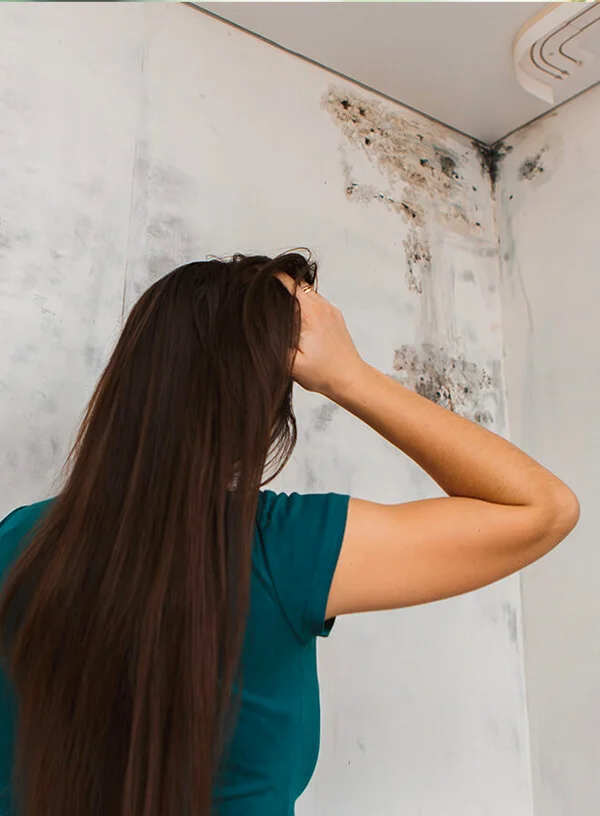

If you’ve spotted dark, splotchy growth on a wall, around a window, or behind a leak, you’re probably already worried. The good news is that most black-looking mold is far more manageable than the internet suggests, and a properly trained crew can often remove it in a single visit. The harder truth is that the mold isn’t the real problem. The moisture that fed it is.
What “black mold” actually means
“Black mold” is a category, not a species. The term gets used for any dark-colored mold growing indoors — most often Cladosporium, Aspergillus, Alternaria, or the one people are usually picturing: Stachybotrys chartarum. Stachybotrys is the species that earned black mold its scary reputation. However, Stachybotrys is far less common than the other dark molds.
Regardless of the species of black mold, the U.S. Environmental Protection Agency and the Centers for Disease Control and Prevention recommend treating them just the same. If you can see or smell mold growing indoors, it needs to be removed, and the moisture source has to be fixed. Lab testing rarely changes the plan; it just changes how nervous you feel about it.
Related: 3 Types of Mold You Should Know
How to tell if you actually have black mold
Where it usually shows up
- Bathrooms: Grout, ceilings above showers, behind toilets, under sinks
- Basements and crawl spaces: Along the bottom of drywall, on joists, on stored cardboard
- Around windows: Especially in older homes with single-pane glass and condensation
- Inside walls: Typically traceable to a roof leak, plumbing leak, or ice dam
- HVAC systems: Inside ductwork, on coil pans, around supply registers
- Attics: On the underside of roof sheathing where ventilation has failed
Symptoms that should put mold on your shortlist
According to the American Academy of Allergy, Asthma & Immunology, the most common reactions to indoor mold exposure include chronic congestion, sneezing, itchy eyes, coughing, wheezing, and worsened asthma symptoms. People sensitive to mold often notice they feel worse at home and better when they’re away for a few days. If multiple people in the house are coming down with the same nagging respiratory symptoms, that’s a strong signal worth investigating.
Should you contact a doctor or a remediation company?
Anyone who suspects black mold and is also experiencing a persistent shortness of breath or a fever should seek a medical professional. Anyone who is immunocompromised and is experiencing any symptoms should consider calling their doctor as a first step. Mold is a possible contributor, but anyone who fits into these categories should take care of their health before they take care of remediation.
Should you try to remove black mold yourself?
The EPA’s general rule: if the affected area is smaller than about 10 square feet (roughly a 3-foot by 3-foot patch), a careful homeowner can usually clean it themselves with detergent, water, gloves, and an N95 respirator. See the EPA’s Mold Cleanup in Your Home guidance for the step-by-step approach.
Call a professional when any of the following are true:
- The visible patch is bigger than 10 square feet
- The mold is on porous material that’s already crumbling — drywall, insulation, carpet pad, ceiling tile
- There’s a known water intrusion you haven’t fixed (roof leak, foundation crack, slab leak, sewage backup)
- The mold is inside an HVAC system, behind a wall, or in a crawl space (more on mold in your HVAC system)
- Anyone in the home is asthmatic, immunocompromised, pregnant, or under five
- You’re selling the home and need documentation a buyer’s agent will accept
How professional black mold removal actually works
A reputable mold removal company will always follow the standards published by the Institute of Inspection Cleaning and Restoration Certification (IICRC), specifically the IICRC S520 standard for professional mold remediation. It’s always a good idea to ask a mold removal company if they’re IICRC certified.
Step 1 — Inspection and moisture mapping
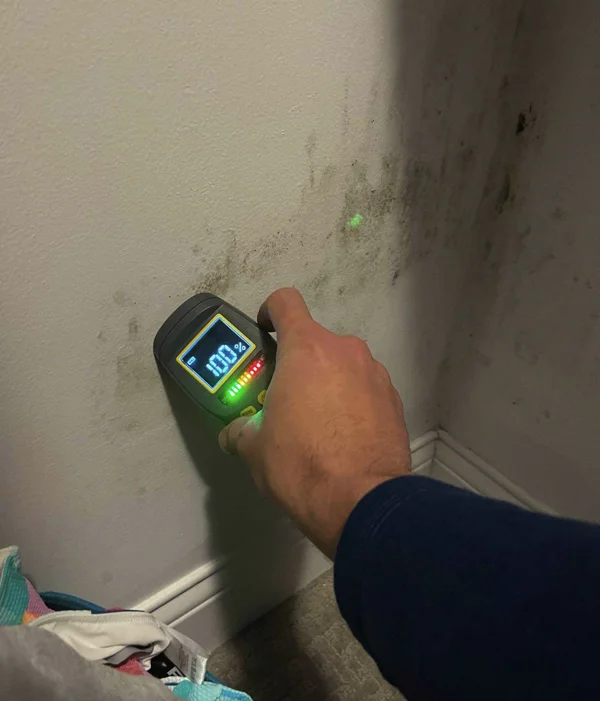
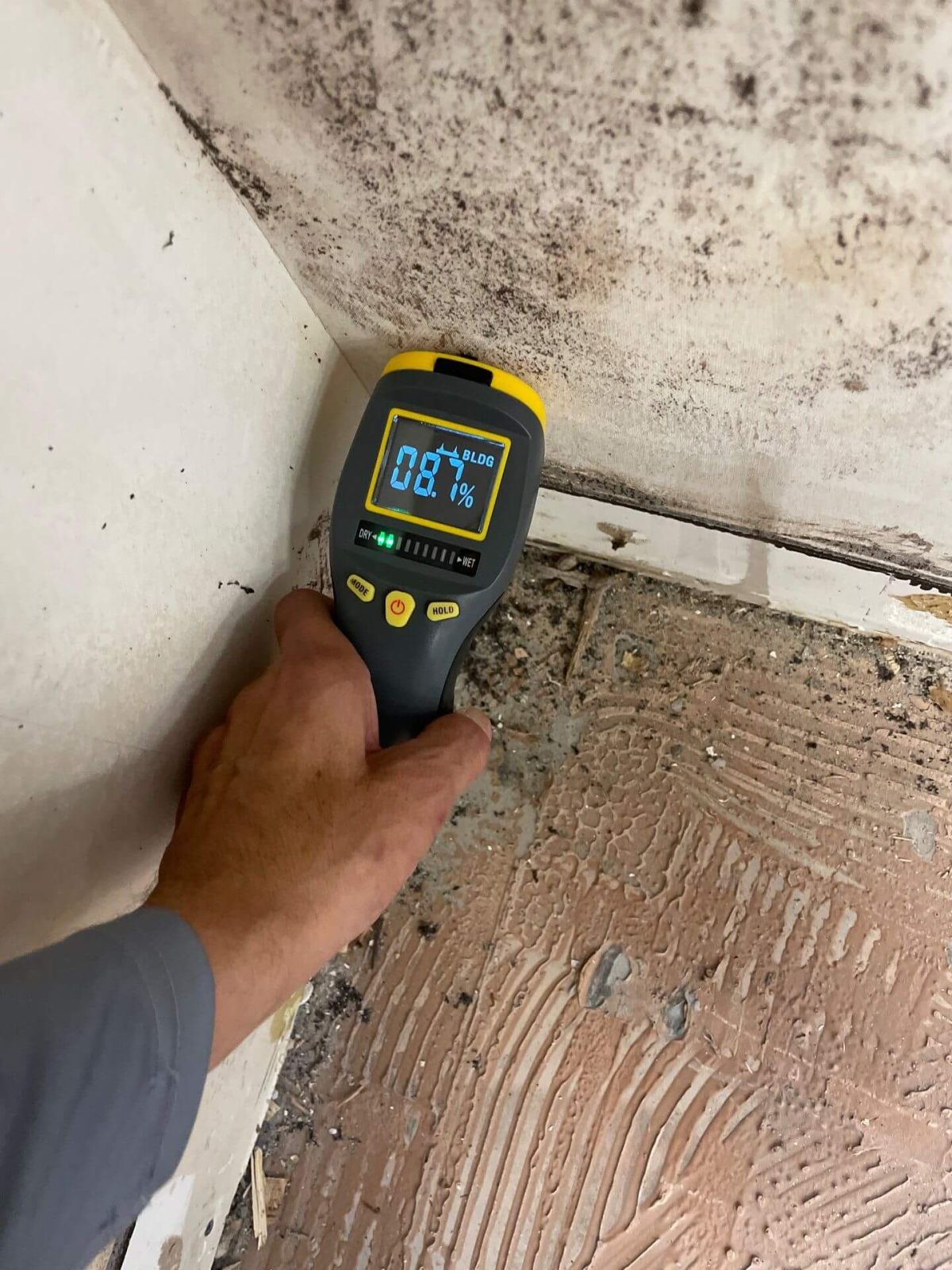
Before anything is touched, a technician documents every visible patch and uses a moisture meter and infrared camera to find what you can’t see: wet drywall behind paint, saturated insulation, damp framing. This is the most important step and the one most often skipped by cheap quotes. If a contractor tries to give you a price without inspecting, that’s a red flag.
Step 2 — Containment
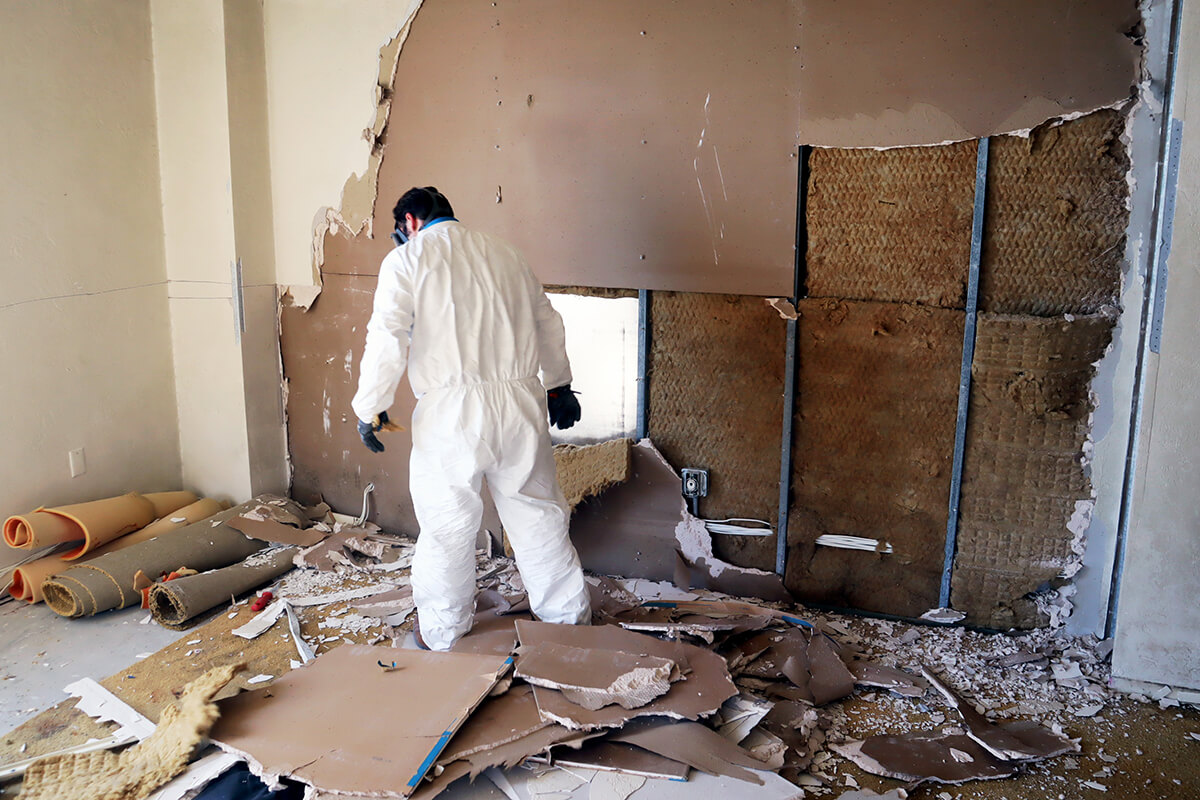
The work area is sealed off with plastic sheeting and put under negative air pressure using a HEPA-filtered air scrubber. This keeps spores from drifting into the rest of the house during removal. For larger jobs, a decontamination chamber is built at the entry point.
Step 3 — Removal and cleaning
Porous materials that are visibly affected — drywall, insulation, carpet pad — are cut out and bagged. Non-porous surfaces (framing, concrete, tile) are HEPA-vacuumed, then treated with an antimicrobial. Pur360 uses a chemical-free, oxidative process that breaks mold and odor molecules at the source rather than masking them, which avoids the bleach residue and harsh fumes traditional remediation can leave behind.
Step 4 — Drying, restoration, and post-verification
Affected materials are dried below 16% moisture content (the threshold below which most mold cannot grow), removed materials are replaced, and the area is post-tested. Pur360 issues a written 100% mold-free certificate, which is the same document home buyers, lenders, and insurers ask for during a real estate transaction.
How much does black mold removal cost in 2026?
Based on Pur360 inspections from more than a dozen major metros, most homeowners end up spending between $1,500 and $6,000 on professional black mold remediation, with the average job falling somewhere near $2,400. The price moves based on five things:
- Affected square footage — a 4-square-foot patch vs. an entire basement wall
- Materials involved — tile and concrete are cheaper to clean than drywall and insulation, which have to be removed and replaced
- Moisture source — if a roof leak, foundation crack, or plumbing failure has to be repaired first, that adds cost
- Access — crawl spaces, attics, and inside-wall remediation cost more than a visible bathroom patch
- Testing — pre- and post-remediation lab testing typically adds $300 to $600
Does Insurance Cover Black Mold Removal?
Homeowners insurance sometimes covers mold remediation, but only when the mold is the result of a covered, sudden water event (a burst pipe, an appliance leak, storm damage). Mold from gradual humidity, deferred maintenance, or flooding is almost always excluded. Read your policy’s mold endorsement before assuming coverage.
How long does black mold removal take?
A typical residential job takes 1 to 5 days from start to finish. Pur360’s chemical-free process is designed to complete most single-room jobs in under 24 hours of active treatment, which is meaningfully faster than traditional bleach-and-tear-out remediation. The schedule depends much more on how much material has to be removed and replaced than on the size of the mold patch itself.
How to keep black mold from ever coming back
The U.S. Department of Housing and Urban Development explains that mold is a moisture problem, not a cleaning problem. Once the existing growth is gone, prevention is about keeping indoor humidity below 50% and fixing water intrusion fast.
- Run a dehumidifier in basements and crawl spaces with a target of 30–50% relative humidity
- Use bathroom and kitchen exhaust fans during and 15 minutes after showering or cooking
- Fix any plumbing leak within 24 to 48 hours
- Inspect the roof and gutters every spring and fall
- Make sure the ground slopes away from the foundation on all four sides
- Insulate cold-water pipes and AC ducts to stop condensation
- Replace HVAC filters on schedule and have ducts inspected every 3 to 5 years
Why homeowners choose Pur360 for black mold removal
Pur360 has been removing mold and odor across the country since 2006 using a patented, process that is chemical-free and backed by a 100% guarantee. Most homes are returned to a fully usable state within 24 hours. The Pur360 team also runs a Realtor Program that delivers fast inspections and mold-free certificates for homes under contract.
“All mold problems start with a moisture issue. If you remove the mold without fixing the moisture issue that caused it, the mold can return rather quickly. As part of our service, we try to identify the source of the issue, so that once the mold is eliminated it never returns.”
— Zak Khoshbin, President, Pur360
Schedule a free mold inspection
If you’re seeing dark patches in your home, request a free Pur360 inspection or call 888-478-7360. We service Chicago, Madison, Milwaukee, Indianapolis, Philadelphia, Orlando, Tampa, San Antonio, Austin, Dallas, Fort Worth, and Houston — see our full list of service areas.